
Recent reports concerning the treatment of teenage Army recruits raise serious questions about safeguarding, professional boundaries and the responsibilities placed on those entrusted with training young people.
One report states that more than 300 Army recruit training instructors have been court-martialled or faced severe disciplinary action over a five-year period for alleged or proven misconduct involving recruits. The cases reported range from bullying and humiliating initiation practices to sexual misconduct involving young trainees.
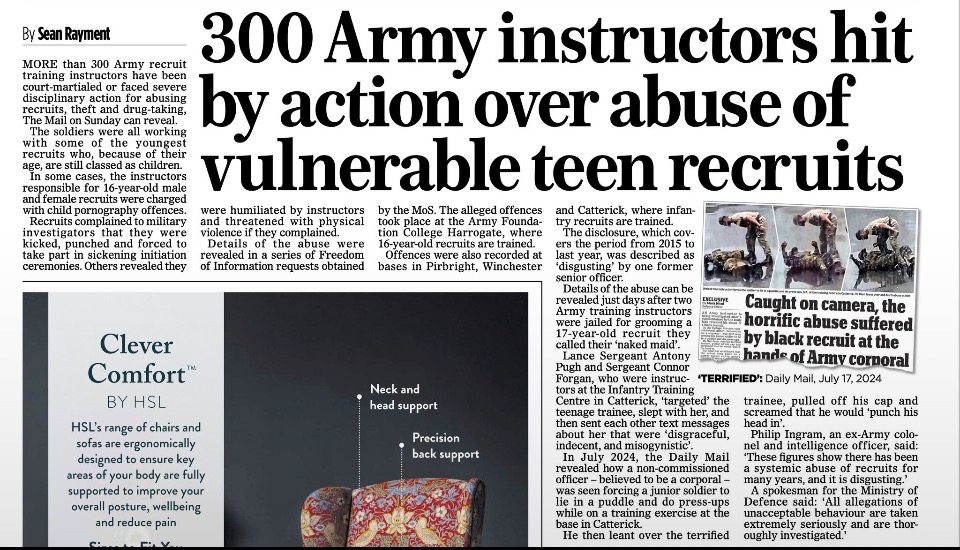
A separate report from January 2026 highlighted the conviction of two Army instructors based at the Infantry Training Centre in Catterick, North Yorkshire, following sexual relationships with a 17-year-old recruit. Both men were convicted of sexual activity with a child by a person in a position of trust and were subsequently jailed and dismissed from the military.
These stories are disturbing individually. Taken together, however, they point towards a wider safeguarding issue: what happens when an organisation responsible for developing young people gives individual instructors considerable authority over recruits who may still legally be children?
A unique position of trust
Military training is deliberately demanding. Instructors need authority to establish discipline, develop resilience and prepare recruits for the realities of service.
However, authority also creates responsibility.
Some Army recruits begin their careers at 16 or 17. Whatever the expectations placed upon them as soldiers in training, those under 18 remain young people who require appropriate safeguarding.
The relationship between instructor and recruit is also inherently unequal. An instructor may influence a recruit’s daily routine, training, discipline and progression. That imbalance makes clear professional boundaries essential.
Sexual or exploitative relationships cannot simply be viewed as private relationships between two individuals when one person exercises significant professional authority over the other.
Safeguarding is broader than sexual misconduct
The newspaper reports also describe allegations involving humiliation, intimidation and initiation ceremonies.
That distinction matters because safeguarding should not begin only when behaviour becomes criminal.
A culture in which degrading treatment is dismissed as “banter”, initiation or simply part of tough training can make it more difficult for young recruits to recognise unacceptable behaviour and report it. It can also make intervention less likely when inappropriate conduct first emerges.
Effective safeguarding therefore requires organisations to pay attention to the entire culture surrounding young people, not merely the most serious incidents that eventually reach a courtroom.
The difficulty of speaking up
Reporting misconduct can be particularly challenging inside strongly hierarchical organisations.
A young recruit may worry that making a complaint will damage their career, attract ridicule from colleagues or lead instructors to regard them as weak or troublesome. They may also be uncertain about whether behaviour they have experienced actually crosses a professional boundary.
That makes accessible and genuinely independent reporting mechanisms particularly important.
Young recruits should know what behaviour is unacceptable, where they can report concerns, what will happen after they make a disclosure, and how they will be protected from retaliation.
Managers and instructors also need the confidence and responsibility to challenge concerning behaviour rather than leaving the burden entirely with the young person experiencing it.
Lessons beyond the Armed Forces
Although these reports concern military training, the safeguarding principles involved extend much further.
Sports clubs, apprenticeships, colleges, residential settings, youth organisations and workplaces employing under-18s can all create relationships in which adults hold substantial authority over younger people.
Organisations working with teenagers should therefore ask themselves difficult questions.
Are professional boundaries clearly understood? Can a 16- or 17-year-old raise a concern without approaching the person responsible for them? Are apparently minor incidents recorded so that patterns can be identified? Do managers recognise grooming, coercion and abuses of authority? Crucially, does organisational culture encourage people to challenge inappropriate behaviour rather than protect colleagues or the institution’s reputation?
Policies are important, but safeguarding ultimately depends on how those policies operate when someone actually needs protection.
Victims must be at the heart of the process
For Diane Askwith, our military claims expert, the reports also highlight a fundamental problem with the way allegations can be handled: the experience of the victim during the investigation itself.
Diane said:
“Unfortunately, victims are not put at the heart of investigations. No wonder they fear reporting in closed environments when investigations are not always conducted thoroughly and there is often ostracising behaviour from others after reporting. I have seen many cases where the alleged perpetrators are allowed to continue serving, whereas the victims are moved out of the place they work, off base and then face discharge from the Forces and careers they loved all for reporting unwanted behaviour which should never have happened in the first place”.
Her comments point to an important distinction between having a reporting procedure and having one that people actually trust.
For a young recruit considering whether to disclose abuse, bullying or inappropriate sexual behaviour, the prospect of an investigation can itself be intimidating. They may fear being disbelieved, blamed, exposed to colleagues, repeatedly questioned or made to feel that their own behaviour is under scrutiny rather than that of the person they have reported.
Accountability must lead to prevention
Court martial proceedings, dismissal and imprisonment demonstrate accountability after serious misconduct has occurred. They cannot, however, undo the harm experienced by a young person.
The more important objective must be prevention.
That means robust recruitment and supervision of instructors, regular safeguarding training, explicit rules governing relationships with recruits, confidential reporting channels, effective investigation of concerns and senior leaders who treat warning signs seriously.
The Armed Forces necessarily demand discipline, resilience and trust. Those qualities should make safeguarding stronger, not provide an excuse for lowering its standards.
Young people entering military service have accepted an unusually demanding challenge. In return, they should be entitled to expect that the adults responsible for their training will exercise their authority professionally and that the institution around them will act decisively when those boundaries are crossed.
The central lesson from these cases is straightforward: toughness and safeguarding are not opposites. An organisation can demand extraordinarily high standards from young people while maintaining equally high standards for the adults entrusted with their welfare.
Military Injury Claims – Part of Ison Harrison Solicitors
The most common claim types that we handle for our clients; to see how we can help call 0113 224 7837, or email: [email protected]












Claim type not listed? Get in touch for a free assessment of your military injury claim. To see how we can help; call 0113 224 7837, or email [email protected]
Diane Askwith heads up the military injury claims team at Ison Harrison Solicitors. Meet The Team